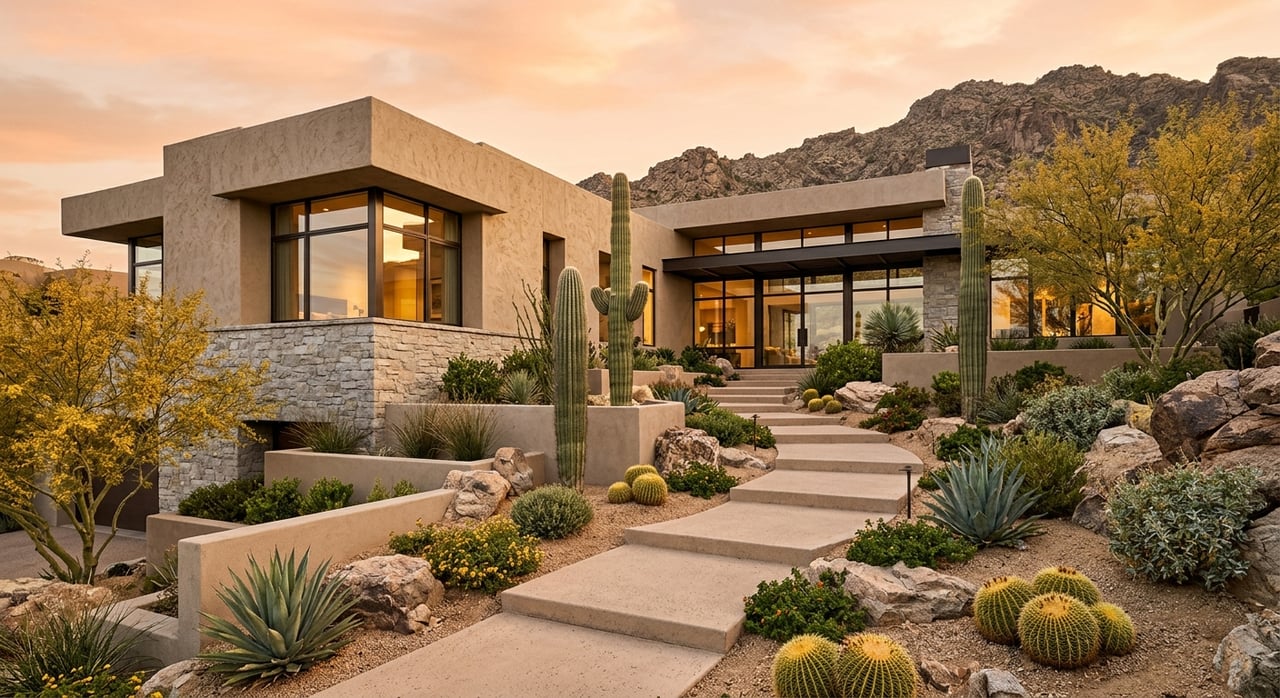
Wondering whether you should buy a finished home or build from the ground up in The Canyons? In a small, high-end foothills enclave like this one, that choice can shape your budget, timeline, and overall experience more than you might expect. If you are weighing lifestyle fit, control, and risk in Tucson’s 85718 market, this guide will help you compare both paths with more clarity. Let’s dive in.
The Canyons market at a glance
The Canyons is a small luxury enclave in Tucson’s 85718 area, and available inventory tends to be limited. Current listing snapshots show just a couple of homes for sale, ranging from a 1.49-acre lot priced at $1 million to a 5.04-acre estate priced at $10 million.
That low inventory matters because it can narrow your choices if you want to buy an existing home. It also helps explain why some buyers consider building, especially when a rare homesite or specific view orientation becomes available.
Market data also points to a premium segment with very little turnover. Redfin reported a median sale price of $3.15 million in The Canyons over the three months ending April 2026, based on one sale, with 44 days on market.
Why buying may make more sense
If your top priority is speed and certainty, buying an existing home in The Canyons often has a clear advantage. You can see the finished floor plan, driveway approach, view lines, and how the home sits on the lot before you commit.
That visibility reduces some of the uncertainty that comes with a custom build. In a foothills setting, details like grading, retaining walls, and pad placement can affect both cost and timing.
Existing inventory in The Canyons also includes homes with features many luxury buyers want right away. Current and recent listings reference gated access, paved roads, guest houses, and association-maintained infrastructure.
What you can evaluate upfront
With a resale home, you can assess major factors before closing, including:
- The actual orientation of the home on the parcel
- The finished landscape and driveway layout
- Whether the interior plan fits your daily living needs
- The level of privacy and how the home relates to neighboring lots
- Existing HOA charges and listed services
This can be especially valuable in a community where each parcel may carry different costs and service levels.
HOA costs can vary
One of the biggest takeaways from current listing data is that association costs are not one-size-fits-all in The Canyons. Examples include one property with a $1,296 monthly HOA fee that includes grounds maintenance, street maintenance, and gated-community access, another with a $350 monthly HOA fee and security or common-area service, and a lot listing with calculated monthly association fees of $1,437.
That spread is significant. If you buy an existing home, make sure you understand the exact monthly charges tied to that property and what those charges cover.
Why building may make more sense
Building can be the better path if you want exact design control and are willing to trade time for customization. In a place like The Canyons, that may mean tailoring the home to a specific pad, view corridor, or indoor-outdoor layout that is hard to find in an existing property.
For some buyers, that level of personalization is worth the added complexity. If the right lot becomes available, building may let you create a home that fits your priorities more precisely than any resale option.
What building requires in Pima County
Pima County’s custom-home submittal process is detailed, and that is important to understand before you move forward. A custom-home permit package must include a site and grading plan showing setbacks, existing and proposed topography, finish-floor and pad elevations, utilities, walls and fences, and the exterior accessible route and accessible entrance.
Engineering is required for walls over 7 feet and retaining walls over 4 feet. If grading exceeds 14,000 square feet, coverage review may apply, although the county notes that for eligible residential building-permit projects, that coverage is automatic, free, and valid for six years.
Permit timing is only part of the story
On paper, county review times are fairly efficient. Pima County targets building-plan review at 5 business days for projects up to 20,000 square feet and 10 business days for larger projects, while site-development instruments are targeted within 5 business days with a 15-business-day guarantee.
Still, permit review is only one step. Design work, HOA or architectural review, contractor scheduling, and actual construction all add time beyond the county’s published turnaround goals.
HOA design review can add calendar time
In communities served by design-review firms working in Canyons at Finger Rock, preliminary and final plan approval often takes 2 to 3 months in practice, even when faster review targets are advertised. That does not mean every project will take that long, but it is a useful benchmark if you are trying to build a realistic timeline.
In other words, building can offer more control over the finished product, but it usually requires more patience. In a luxury foothills setting, small site decisions can carry big design and cost implications.
Cost factors to compare carefully
Price is only one part of the decision in The Canyons. You also need to compare carrying costs, approval costs, and how long your capital may be tied up.
Buying existing: more known costs
With an existing home, your costs are generally easier to identify early. You can review the asking price, estimated monthly ownership costs, and the property’s known HOA structure before making a decision.
That does not remove every surprise, but it does give you a clearer picture of what you are buying today. In a low-inventory luxury market, that certainty has real value.
Building: more moving parts
Building usually comes with additional line items and more timing risk. Pima County’s current transportation impact fee is $9,149 per single-family detached unit through September 30, 2026, plus a $75 administrative fee, and the county notes that permit fees also include building, sewer connection, and transportation impact components.
You also need to account for site work that may vary sharply from lot to lot. Grading, retaining walls, utility access, and driveway work can all affect your final cost.
Financing and insurance differences
Financing a build is different from financing a resale purchase, and that difference should be part of your decision from the start. During construction, buyers should expect a short-term construction loan rather than a standard mortgage.
The research also notes that construction loans are generally short-term and often carry higher rates than longer-term mortgage loans. Construction-to-permanent financing typically does not convert until construction is completed.
Insurance is another point to clarify early. If you build, make sure you know who is carrying builder’s risk coverage, since that is the policy designed to cover the structure and materials while the home is under construction.
A practical decision framework
For many buyers in The Canyons, the decision comes down to what you value most.
Buying existing may be the better fit if you want:
- A faster path to closing
- More certainty on the finished product
- Fewer approval-related unknowns
- A clearer view of monthly carrying costs
- Less exposure to construction and timeline risk
Building may be the better fit if you want:
- Exact design control
- A specific lot, pad, or orientation
- A custom floor plan tailored to your lifestyle
- The chance to create something hard to find in resale inventory
- Flexibility to prioritize your own finishes and layout from day one
In a community with limited inventory, both paths can be smart. The right answer depends on your timeline, your tolerance for complexity, and how important customization is to your long-term enjoyment of the property.
Questions to ask before you decide
Whether you are buying or building, clear questions can save you time and protect your budget. In The Canyons, these are some of the most useful ones to ask.
Questions for a resale purchase
- What are the exact monthly HOA or association charges for this property?
- What services are included in those fees?
- Are roads paved, and who is responsible for road maintenance?
- What community documents should I review before closing?
- How does this home compare with other finished properties in The Canyons and the broader Catalina Foothills market?
Questions for a custom build
- Which lots appear to need the least grading or retaining-wall work?
- Which utilities are already at the lot line?
- What are the exact architectural review steps and expected response times?
- What is the realistic permit-plus-construction schedule?
- Who carries builder’s risk coverage during the project?
- How are interest draws handled during construction?
- What finished homes should be used to establish a target price ceiling for the build?
Before closing on either path, it is wise to request the HOA estoppel, current budget, CC&Rs, and design-review rules. In The Canyons, association charges and services can vary sharply by lot and home.
The bottom line on buying versus building
In The Canyons, buying and building are not simply two versions of the same decision. They are two very different paths with different timelines, risk profiles, and levels of control.
If you want speed, clarity, and a more predictable process, buying an existing home may be the stronger move. If you are focused on customization and are comfortable with a longer timeline and more variables, building may offer the better long-term fit.
Because this is a low-volume, high-value enclave, the details matter. A local, data-driven review of inventory, lot conditions, HOA structure, and realistic build timing can make the difference between a good decision and a costly one.
If you are comparing options in The Canyons or anywhere in Tucson’s foothills, Judy Smedes & Kate Herk can help you weigh the tradeoffs with the kind of local insight and high-touch guidance that luxury properties deserve.
FAQs
Should you buy or build in The Canyons in Tucson?
- If you value speed, certainty, and fewer moving parts, buying may be the better choice. If you value exact design control and are comfortable with a longer timeline, building may be worth the extra effort.
How many homes are usually for sale in The Canyons?
- Inventory appears to be very limited. Current market snapshots showed only two homes for sale, which is one reason some buyers explore building when a suitable lot becomes available.
What HOA costs should you expect in The Canyons?
- HOA and association charges can vary widely by property. Recent examples ranged from $350 per month to more than $1,400 per month, with different service levels tied to different homes and lots.
How long does it take to permit a custom home in Pima County?
- Pima County targets 5 business days for building-plan review on projects up to 20,000 square feet and 10 business days for larger ones, but your full timeline can be longer once design review, HOA approvals, and construction are included.
What extra costs come with building in The Canyons?
- In addition to construction costs, you may need to budget for permit-related fees, transportation impact fees, grading, retaining walls, utility work, and carrying costs during the build period.
What documents should you review before buying in The Canyons?
- Before closing, ask for the HOA estoppel, current budget, CC&Rs, design-review rules, and a clear breakdown of association charges and included services for the specific property you are considering.